Veeam brings many big changes to backup storage, mainly around object storage,
That can be S3, Azure blob, Aws, Wasabi, On-Prem Object storage, but also some deduplication appliance support improvements.
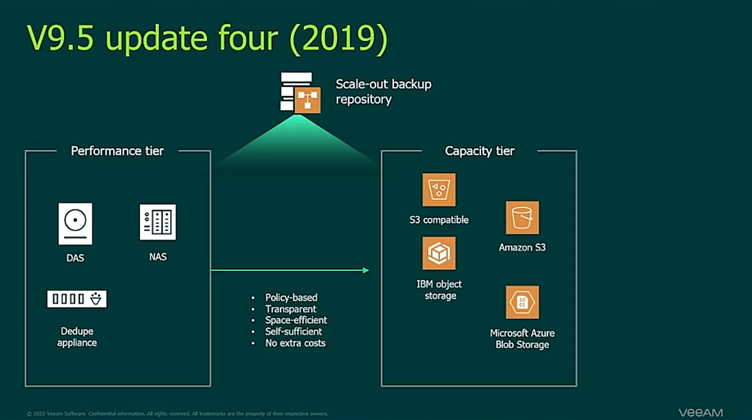
Firstly, and most importantly backup directly to object storage. the move to using object storage started in 2019 and V9.5 so let’s cover of how we got to this point so we can properly understand what is new.
In Veeam 9.5 Veeam added object storage but with a limited “move” mode that copied data to S3 once it was outside of the operational restore window. Effectively being more of an archive of older restore points.
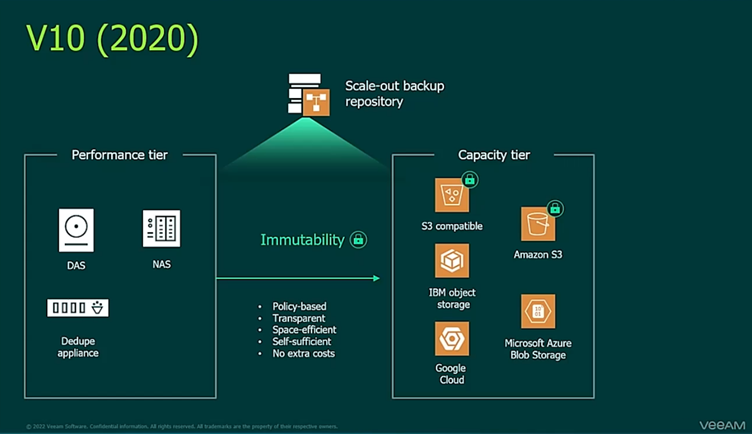
In V10 Veeam added immutability and the “Copy” mode. This gave a proper copy of data as soon as the backup completed into S3 storage and enabled object lock to protect the data from ransomware. This is when the landscape really started to change.
Immutability allowed for the copy to be protected and therefor considered a fully-fledged secure copy. Azure still didn’t support object lock so fell behind on the uptake.
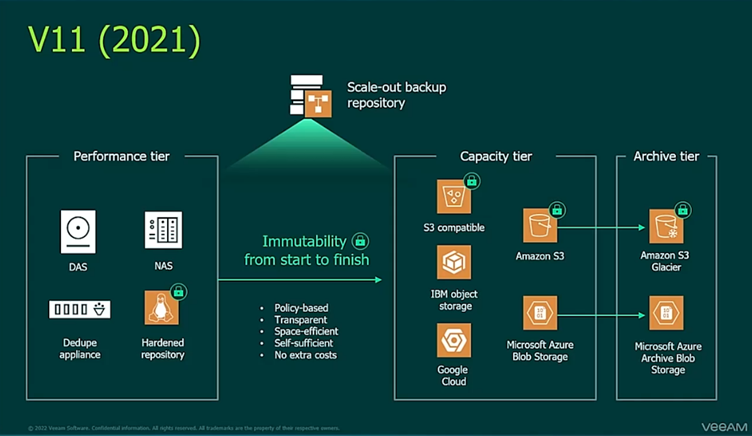
In V11 Veeam added support for the archive tier of object storage if you used blob or AWS S3 as the capacity tier. Unfortunately, it didn’t support S3 on prem or S3 compatible to archive. A missed opportunity in my mind but I understand the development overhead for this.
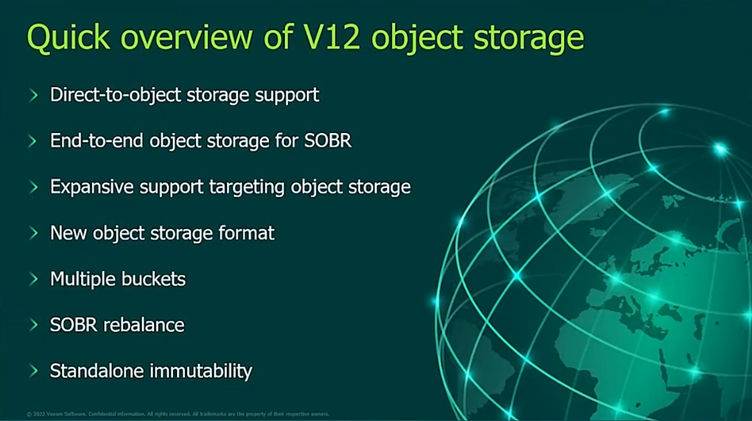
So, what does V12 bring for backup storage?
The following types of backups are supported.
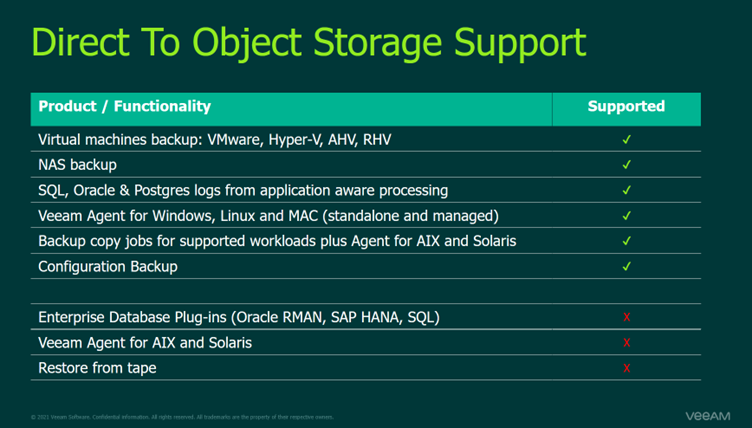
Note that the native plugin backups for SQL and Oracle, as well as AIX and Solaris will still need to go to standard performance tier local backup disk.
If you need to consider the ability to restore from tape at all, you will still need normal disk as tape staging for granular restores.
We can see in the below slide that an all-object storage solution is now possible. Using cloud tier as primary repository then offload direct to archive for long term backup retention. Keep in mind though that early deletes of anything below 18 months will apply so best to keep the archive tier of storage for year ends copies and capacity tier for month end copies.
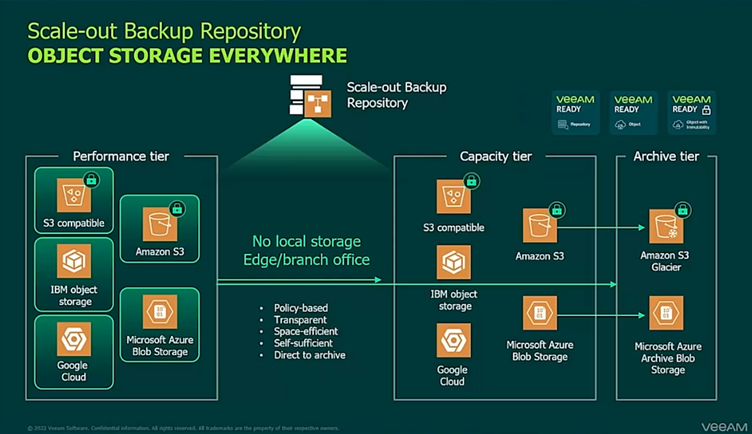
Backing up directly to object storage opens up a wealth of choice when it comes to backup design options. Direct to object does not have to mean direct to cloud. It can be used to backup directly to onside S3 for full redundancy and immutability in the local primary backup, so all the benefits of scale, redundancy, and immutability at all tiers.
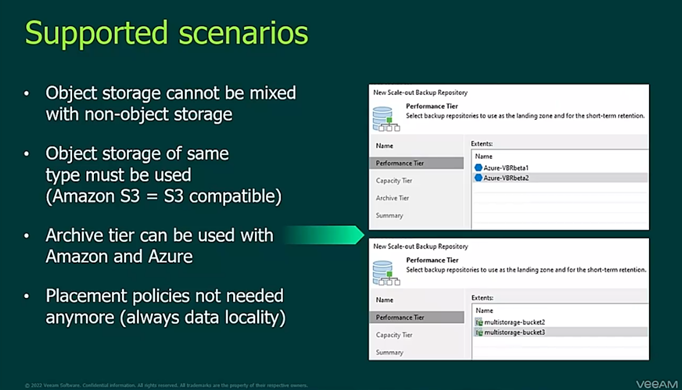
There are some limitations, but they are nothing that would not be expected, such as you cannot mix storage types. You cannot go from AWS S3 to Azure Blob. But this is to be expected.
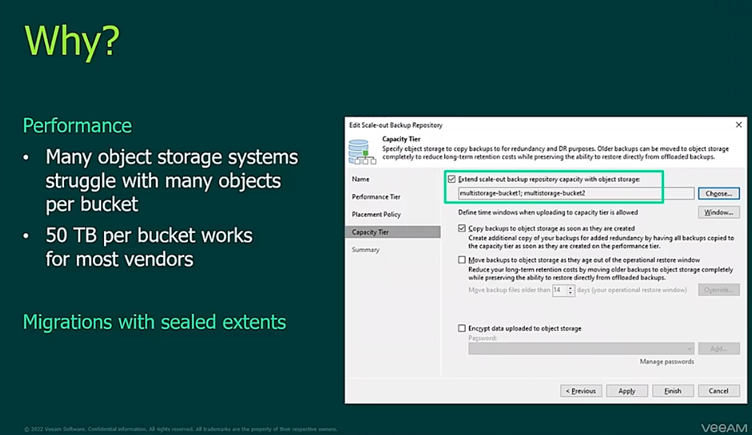
A new object storage format is also in place for V12, this will improve performance by addressing some of the large calls made to the object storage platform. There are also now multiple buckets per SOBR, workloads bigger than 50TB can be split across server buckets to help with performance.
There is also a new SOBR rebalance option. Unfortunately, it takes the SOBR offline to do it which might be a problem for some large SOBR’s backups will not run while the rebalance is active.

Personally, I think more SOBR intelligence and some options around data placement when backups are first written to the SOBR would be much better. The ability to instruct Veeam on either a “Fill and Spill” or a “Spill and fill” policy would help. This would allow for the extents to either fill up one by one before spilling over to the next or in a balanced nature fill them all as equally as possible.
Veeam is not great at data placement in the SOBR, and this is a longstanding issue. I have seen Veeam fill up one disk, run out of space and fail before using other empty extents in the SOBR. So, while this rebalance feature is welcome. I don’t think it goes far enough, or more importantly I think it is a fix to a problem after the fact. More effort to keep the SOBR extents balanced in the first place would be more welcome.
Direct to object storage from agents is a great new feature.
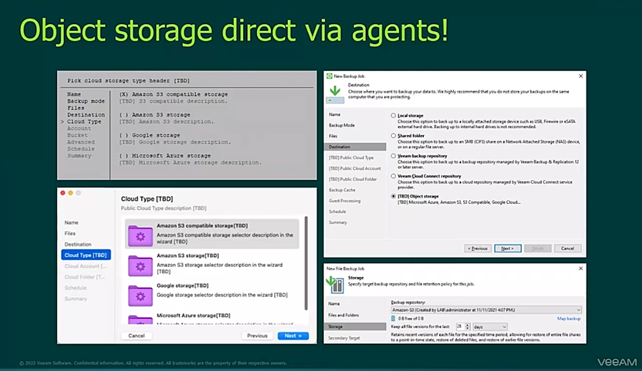
Offloading agent and NAS data directly to object and bypassing the backup server disk is a great option for large datasets.
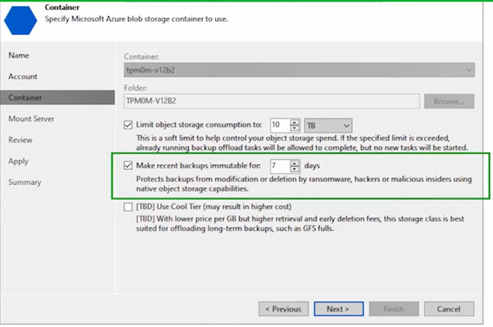
V12 also bring immutability support for both Azure Blob storage and Veeam first Deduplication appliance immutability in the form of the HPE StoreOnce.
All in all, these improvements not only add performance fixes, they add new features that will change the way we design backup solutions going forward in the same was Veeam V10 did with immutability.

Add comment
Comments